
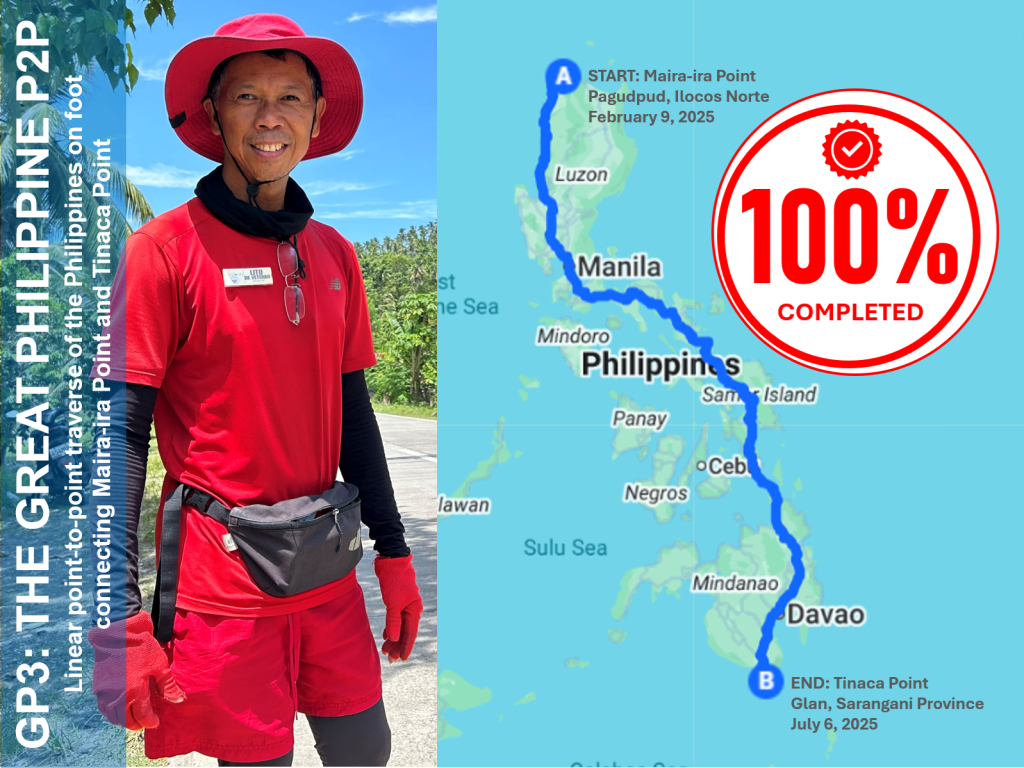
The GP3: Great Philippine P2P (Point-to-point) is defined as a linear, point-to-point traverse trail in the Philippines connecting Maira-ira Point in Pagudpud, Ilocos Norte (the northernmost point of Luzon island) and Tinaca Point in Glan, Sarangani (the southernmost point of Mindanao island).
Challengers can carve their own route starting from any of the two points. No checkpoints, no passport required. Just connect the two points utilizing low-impact, low-waste practices. Use of motorized vehicle is discouraged.
Walking in sections allowed? Yes. GP3 may completed in chunks. Challengers can accomplish it by doing sections, starting from any point along the route he/she designed for himself/herself.
The GP3 was formally established by Lito De Veterbo upon completion of his traverse of the Philippines on foot from February 9 to July 6, 2025, a feat that earned him a Guinness World Record for the fastest crossing of the Philippines on foot spanning 147 days 1 day 39 min 53 sec. The route he took was via KM 0 in Manila and Bicol region.
GP3 is about Low-impact, Low-waste Travel – Not Speed
As a national campaign for environmental awareness, GP3 aims to promote responsible travelling and outdoor ethics by using low-impact, low-waste practices, defining GP3 as a non-motorized route between the northernmost point of Luzon island and southernmost point of Mindanao island in the Philippines. It is not be treated as a race, but rather as a means to convey the message that cross-country travel is possible without causing any damage or disturbance to the places we visit.
Documentation
Documentation is on the discretion of the challenger. However, if he/she intends to create a record of the challenge, it must be done through the use of GPS, providing verifiable kml files that anyone can view. Support documentation would come in the form of contextual photos and videos demonstrating the locations covered, as well as the date and time. If documentation is part of the plan, it would be best to register the journey.
Registration
If a challenger attempts to take on the GP3 with full documentation, registration is recommended, although is it not required. Registration means that the attempt would be on record, be verified, and the result would be published for recognition.
Guidelines and how to register – Soon!
 Long-distance walking across the Philippines